When Natalia Lafourcade returned to her home in Xalapa, Mexico, after a long period of traveling and performing, she found a withering garden with only a few blooming flowers. Lafourcade was getting used to being at home again when the pandemic hit, and like the rest of the world, she had to face prolonged isolation. It not only meant she had to reprogram her quotidian routine after being on the road, around large crowds and bursts of energy, it meant she had to reconnect with her home and a part of herself she had not nourished in a long time, her inner garden.
After seven years, the Mexican singer-songwriter is releasing “De Todas Las Flores,” her first all-original album since her Grammy-winning 2015 LP, “Hasta la Raíz.” It is Lafourcade’s most personal collection of new material, an album she describes as her musical diary. “That’s why the album is called ‘De Todas Las Flores’ because I felt like I was the garden with not many flowers left in me. I needed to connect to that universe again,” Lafourcade tells LATINA during her visit to New York City, where she premiered “De Todas las Flores.” Live at Carnegie Hall, she was joined by guests Omara Portuondo, David Byrne, and Jorge Drexler.
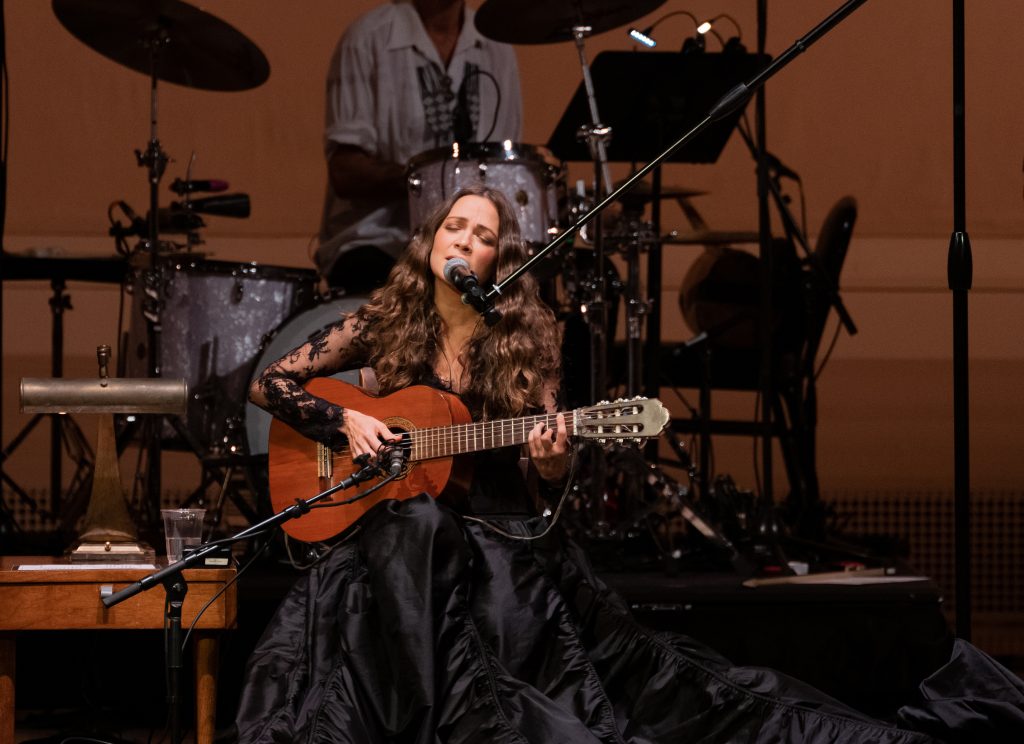
Lafourcade performing “De Todas Las Flores” at Carnegie Hall October 27, 2022. Image by Lawrence Sumulong
The album “De Todas Las Flores,” follows a period of time that began in 2012 but gained momentum in 2015 and continued through 2020 when her musical style shifted. Although the singer-songwriter launched her career in the early 2000s and became one of Mexico’s most beloved post-rock talents — collaborating with contemporary pop singers like Ximena Sariñana and Julieta Venegas — it was her folkloric albums like “Musas I and II” that established her as one of the most successful singers in Latin America.
As the daughter of Gaston Lafourcade, a harpsichordist who served as a music professor and mother, Maria del Carmen Silva Contreras, a pianist and also a music educator, Lafourcade was exposed to classical and folkloric music at a young age. When she began recording the homages, she felt connected to all the great composers and singers she had grown up listening to. “It was beautiful for me, and I was learning a lot. So I really got into that, not noticing that I was leaving aside an important part of my story,” she tells LATINA, “which is me as a songwriter, me as an artist, or creator of my universe, my sound, my ideas.”
Lafourcade explains that around 2017, she began thinking about working on her own material again, but the timing was not right yet. She wanted to continue performing and traveling, something she truly loves (and did for a couple more years), but she knew she had to begin planning for her return home, back to her family, back to her studio.
During the initial phases of her creative process, she wondered if she had it in her to produce an all-original album again. Lafourcade searched through voice memos for songs, clips, and lyrics she had worked on during her tours over several years. That is when Lafourcade came across a song she had written in 2018 after a romantic breakup, a sadness she had tucked away in her memories.
Although the song came from a place of agony and heartbreak, Lafourcade heard her voice and sound again. This song would become the first single and name of the album “De Todas Las Flores,” a dedication to those we loved and lost. It references the inner flowers that have withered and the ones still blooming.
In the summer of 2020, Lafourcade reached out to her good friend, filmmaker, actor, and musician, Adan Jodorowsky — son of the Chilean-French avant-garde filmmaker Alejandro Jodorowsky. Lafourcade explains that she chose him to produce this personal album because she wanted to work with someone that felt like family, someone that shared her taste in music. She adds that she wanted to incorporate his aesthetic and imagination into her work.
In a podcast produced by Lafourcade herself, titled after the new album, she shares the intimate processes of creating “De Todas las Flores.” In the first episode the listener is introduced to the first guest, Jodorowsky. It includes their first conversations about producing the album and his impressions of the early versions. From the beginning, he convinced Lafourcade to avoid digital recording and a click track, opting to record the tracks live on analog tape in a Texas border town near El Paso. Jodorowsky also brought accomplished musicians like guitarist Marc Ribot, bassist Sebastian Steinberg (Soul Coughing, Fiona Apple), and the French percussionist Cyril Atef.
After seven years, Lafourcade has reinvented herself, re-emerging again as the artist and songwriter she is. “It wasn’t until I had silence and emptiness and I had to be at home that I was able to perceive that there was something inside that did not allow me to be at peace. I had to go back to the studio. And I was able to see how much I love making music. My inner child was alive again. I was playing the music.” Through her music, Lafourcade had to revisit those moments of heartache and agony to allow herself to let go of the dead flowers, and plant new ones.
Fans captured clips of her performance at Carnegie Hall on October 27, 2022, including a final standing ovation beside Byrne, Drexler, Portuondo, and more.


Post comments (0)